


CUSTOM-MADE POLYESTER NETS AVAILABLE
Polyester Net, also known as PET Net, is a versatile synthetic netting material used in fishing, aquaculture, sports, protection and other professional applications where stable dimensions and durable net construction are required.
Twisted, braided, monofilament, multifilament and knotless constructions can be produced with custom mesh sizes, net dimensions, knot types, colors and finished configurations according to buyer requirements.
Different applications require different twine constructions, mesh sizes, finished dimensions and net assemblies. Polyester netting can be produced according to an existing specification or developed around the final application.
We can manufacture according to:
Different polyester net structures can be selected according to handling, installation and finished product requirements.
Traditional twisted construction available in different twine sizes and mesh specifications.
Braided construction is available for projects requiring a different twine structure and finished net performance.
Different filament constructions can be produced according to the required specification and final application.
Knotless polyester netting is available for applications requiring a smooth and flexible mesh structure.
Polyester generally stretches less than nylon, helping the net maintain its intended shape and dimensions.
Suitable for applications involving repeated handling, installation and contact with surrounding structures.
Custom mesh construction can be produced according to the required application and installation conditions.
Mesh size, dimensions, construction, knot type and color can be adjusted according to buyer requirements.
Polyester Net and Nylon Net can look very similar when they use the same color, mesh size and twine diameter, but their material behavior is different.
Generally has lower stretch and better dimensional stability, making it suitable where maintaining net shape is important.
Generally offers greater stretch and flexibility, making it suitable where elasticity and impact absorption are more important.
Appearance alone may not be enough to identify the material. Existing nets should be confirmed through specifications, supplier information or appropriate material testing.
Polyester netting can be supplied at different processing levels depending on the buyer's production and purchasing requirements.
Suitable for buyers who complete cutting, assembly or additional processing locally.
Net panels can be cut according to requested dimensions before shipment.
Finished net products can be manufactured according to drawings, samples and application requirements.
Border finishing, rope attachment and other finished processing can be discussed according to the project.
Polyester netting can be customized for selected commercial fishing and fishing net applications.
Suitable specifications can be produced for selected fish farming and marine aquaculture applications.
Polyester netting can be produced for sports, barrier, training and facility applications.
Custom dimensions and finished constructions are available for other professional netting applications.
Suitable for:
Net Distributors • Wholesalers • Importers • Fishing Companies • Aquaculture Companies • Sports Suppliers • Project Buyers
Custom, OEM and bulk production can be arranged according to different specifications, applications and market requirements.
You can send us:
We can use these details to help confirm the required Polyester Net before production.
Need help choosing the right net specification? Please refer to the guide images below.

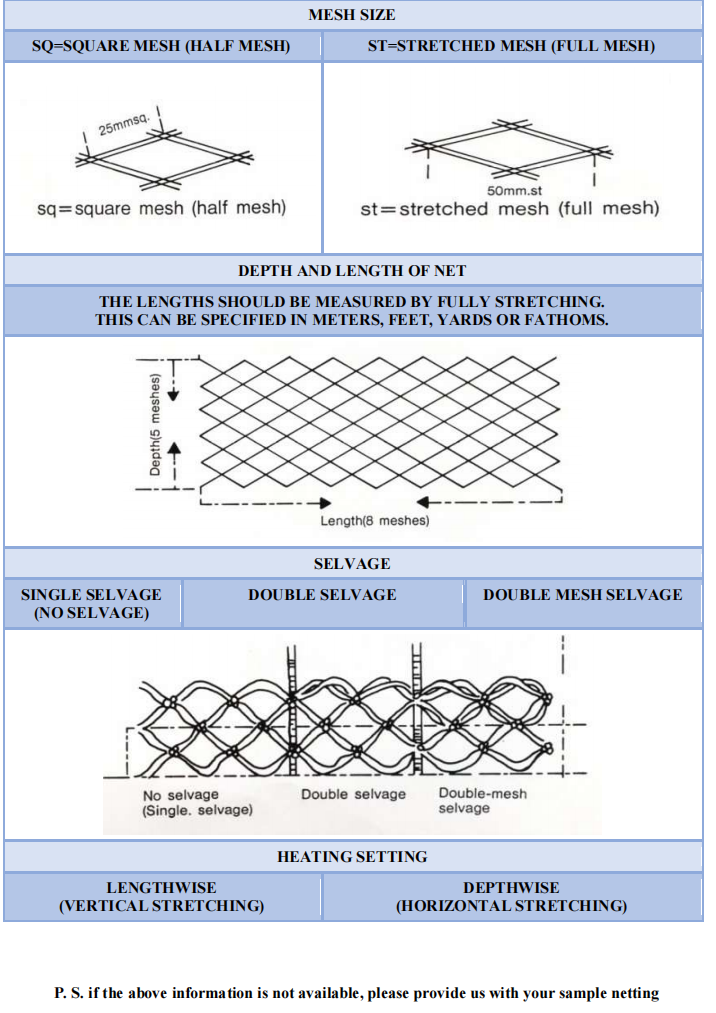
Send us your mesh size, twine specification, dimensions, drawing, sample or application requirements and let us prepare a tailored Polyester Net solution for you.
CUSTOM PRODUCTION • OEM • BULK ORDERS • FINISHED NET SOLUTIONS


